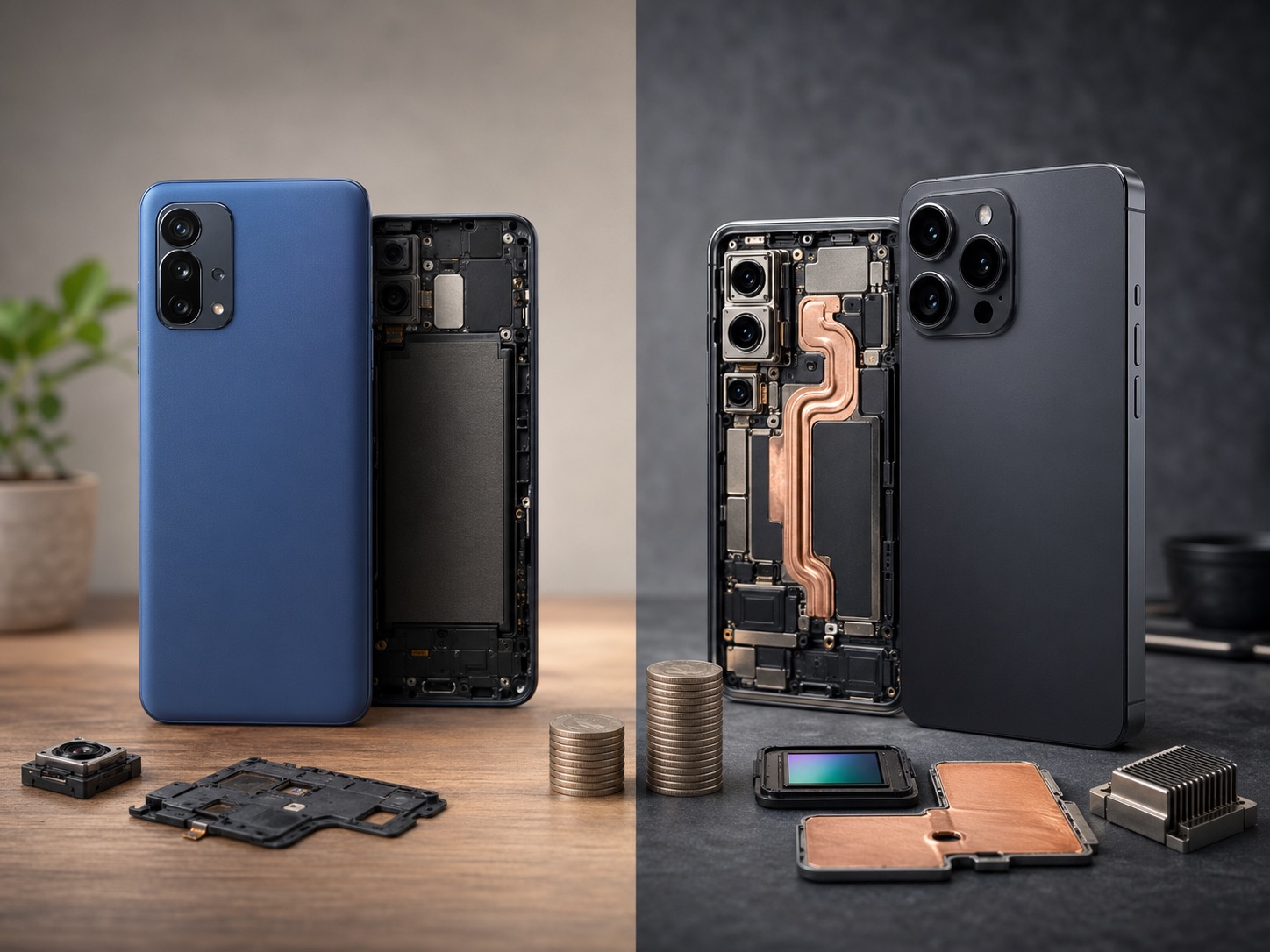
A 2026 mid-range phone costs around 50,000 DZD. A flagship from the same brand, same year, costs 180,000 DZD or more. That's a 3.6× multiplier, and brands work hard to make you think it's justified by the spec sheet.
Some of it is. Most of it isn't. Here's the honest breakdown of where the extra money goes, and where it doesn't.
Where the money clearly goes (worth it)
These are the gaps where a flagship is meaningfully better, and the difference shows up in daily use.
The main camera sensor
Mid-range cameras are fine in good light. Flagships are fine in any light.
The gap is the sensor size. A flagship typically has a 1/1.3" or larger main sensor that physically gathers more light per pixel. A mid-range typically has a 1/2.0" sensor. That difference is invisible at noon outdoors and brutal in a restaurant at night.
If you take photos of people indoors, of food, or anywhere the lighting isn't perfect, this is the single biggest reason to pay flagship money.
Sustained performance
Mid-range chipsets hit similar peak benchmark numbers to flagships from a year or two ago. Where they fall apart is sustained load, gaming for 20 minutes, exporting a video, multitasking heavy apps.
The gap is thermal management. Flagships have vapor chambers, graphite layers, and over-engineered cooling. Mid-ranges have a sticker. Run them for 10 minutes and the flagship maintains performance while the mid-range throttles to 60% of peak.
Update commitment
Samsung, Google, and Apple all promise 6-7 years of OS updates on flagships. On their mid-ranges, it's 4-5 years. Smaller brands offer 2-3 years.
That difference shows up at resale. A 4-year-old flagship still receives security updates. A 4-year-old mid-range is in cryptographic limbo, increasingly locked out of banking apps that demand current OS.
Where the money goes (but you probably won't notice)
These differences are real on paper but rarely change daily life.
Peak display brightness
Flagships hit 2500-3000 nits peak. Mid-ranges hit 1000-1500 nits. Sounds like a huge gap.
In practice, both are fine indoors. Outdoors, both are readable. The flagship is more readable in direct sunlight, which matters if you live somewhere with intense sun (which, fair, applies to most of Algeria in summer). But the gap is gradient, not binary, mid-range users don't actually struggle.
Wireless charging speed
Flagships do 25-50W wireless. Mid-ranges do 15W or none.
This matters if you wireless-charge frequently. Most people don't. Cable charging is the default on both.
Telephoto zoom
Flagships have a dedicated 3× or 5× optical zoom lens. Mid-ranges crop the main sensor digitally.
Telephoto is the lens you use least. Look at your camera roll, count the zoomed-in shots. For most people it's under 5%. If you're a concert/sports/wildlife photographer, telephoto matters a lot. If you're not, it's a feature you'll use twice and forget about.
Build materials
Flagships have titanium frames, ceramic backs, sapphire camera glass. Mid-ranges have aluminum or "glasstic" plastic backs.
In a case (which most people use), this gap disappears. Without a case, the flagship is more dent-resistant. With a case, both feel identical.
Where the spec sheet lies
These are differences brands love to advertise but barely matter in practice.
RAM beyond 8 GB
Flagships now ship with 12, 16, even 24 GB of RAM. Most mid-ranges have 8 GB. The marketing implication is that flagships multitask better.
Reality: iOS uses ~4 GB total. Android uses ~6 GB total. Anything beyond 8 GB is sitting empty until you stress-test it with synthetic benchmarks. Real-world app switching is identical at 8 GB and 16 GB.
Storage speed (UFS 4 vs UFS 3.1)
App opens are faster on UFS 4 by milliseconds. You will not feel this. The marketing copy showing a graph going "up and to the right" is technically accurate and humanly meaningless.
Refresh rate above 120 Hz
Some flagships now boast 144 Hz or 165 Hz. Mid-ranges max out at 120 Hz.
The jump from 60 Hz to 90 Hz is huge. From 90 Hz to 120 Hz is noticeable. From 120 Hz upward, you need to be told it's there.
The honest verdict
Pay flagship money if any of these apply:
- You take indoor/low-light photos regularly
- You game seriously on the phone
- You keep phones for 4+ years
- You travel and rely on the camera as a primary
Pay mid-range money if:
- You take photos mostly outdoors and on social
- You replace phones every 2-3 years anyway
- You game casually
- You spend most of your day in messaging, social, and browser
The 130,000 DZD difference between a Galaxy S25 Ultra and a Galaxy A55 will buy you a lot of things. Whether it should buy you a phone is the question to actually answer.
We have both tiers fully spec'd on Nestphones, with side-by-side comparisons that highlight the spec gaps and (importantly) what they translate to in real use.


