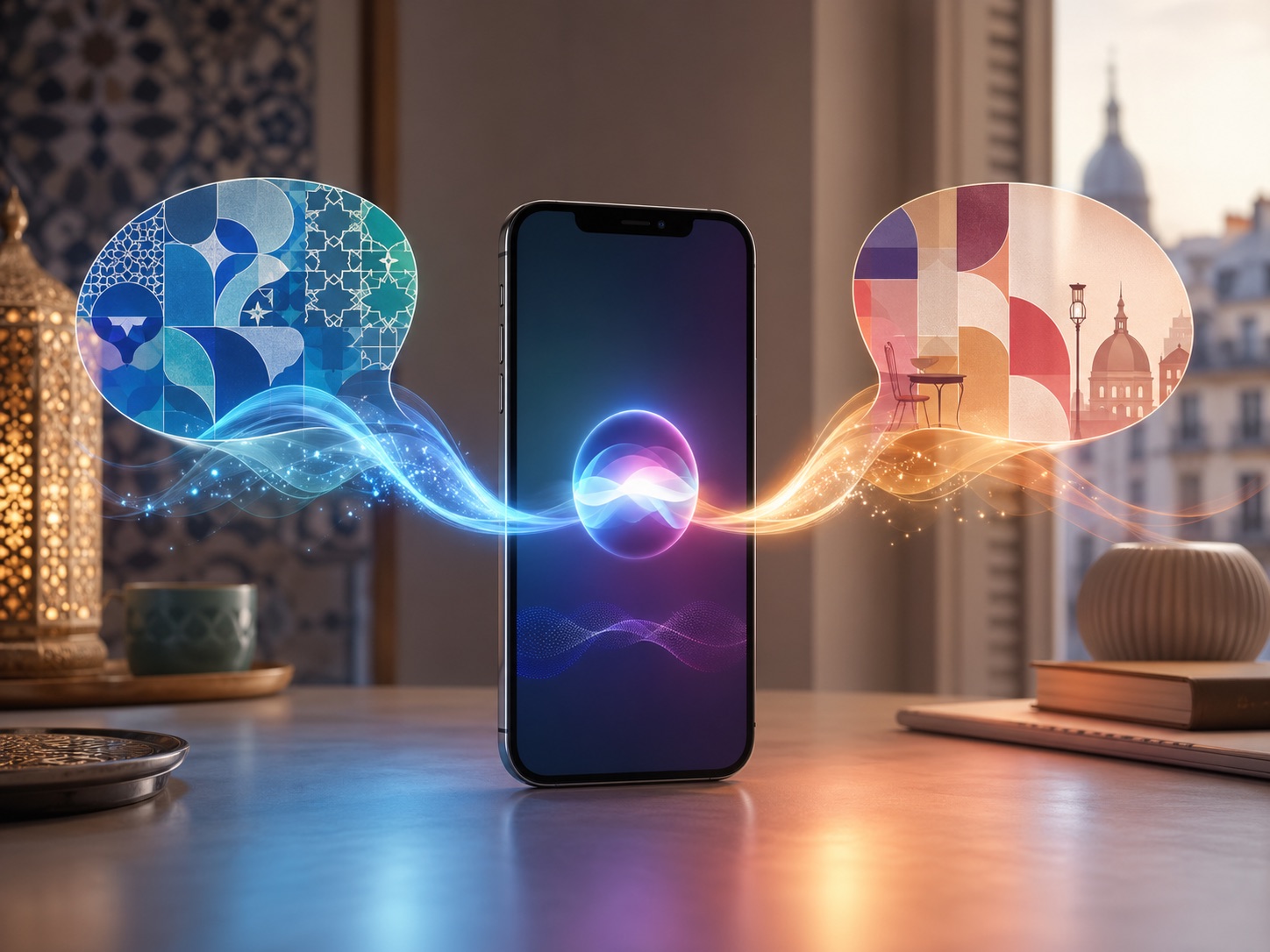
Apple's spring 2026 Apple Intelligence revamp leans on Google's Gemini for the new Siri. Reports from late March confirmed Apple is distilling Gemini into smaller, on-device models that run inside iOS 27 without phoning home for every query. It's the most consequential change to Siri since 2011, and the questions we're actually getting from readers in Algiers are very different from the ones tech press in California is asking.
Here's a practical translation, what changes for you, what doesn't, and what to watch before paying flagship prices for "AI features".
What "distillation" actually means
If you've heard the word and nodded, here's the short version. Distillation is training a small model by feeding it the answers and reasoning of a much larger one. The small model doesn't have Gemini's full knowledge, but it learns to produce Gemini-like outputs for the kinds of questions phones are asked.
Why this matters for Algeria specifically:
- These distilled models run locally on the phone. No data round-trip to a server.
- Local means it works in airplane mode, in the metro, in lifts, between Algerian wilayas where 4G drops to 3G, and well before VoLTE / 5G reach your neighborhood.
- Local also means no Algeria-region availability gap, the model doesn't need to "support" your country to run, because it isn't a service.
That's the theory. The product is more complicated.
Which Apple Intelligence features unlock in Algeria
Here's where most users get burned. Apple Intelligence is a mix of on-device features and server-side ones, and the server-side parts are gated by region.
What works in Algeria today (Region: Algeria, language: French or Arabic):
- On-device summaries of notifications, emails, and Messages
- Writing tools (proofread, rewrite tone, summarize) in supported languages
- Image cleanup in Photos, on-device only
- The new on-device Siri (once iOS 27 ships)
What's gated to specific regions and probably won't reach Algeria in the first wave:
- ChatGPT integration in Siri (US/EU rollout first)
- Image Playground for generation, depends on regional content rules
- Genmoji, same gating
- Some web-search features that route through Apple's server-side stack
The workaround a lot of people use, switching iPhone region to France or US, breaks more than it fixes. App Store payment, banking apps, Apple Pay region locks, weather and Maps localization all degrade. Don't.
Arabic, French, Darja, the language reality
Arabic is officially supported by Apple Intelligence. French has been since launch. Darja is not a supported language anywhere, on any platform, and asking why is a fair question with a frustrating answer, no major model treats it as a first-class target. The training data isn't there.
What this means in practice:
- Siri responds well in Modern Standard Arabic and in French
- Mixed-language prompts ("rappelle-moi demain à neuf heures of أن أعيد الاتصال بـ مديري") work surprisingly well, modern models handle code-switching
- Pure Darja prompts get translated mentally to MSA before they're processed, with predictable accuracy hits
- Voice transcription quality follows the same hierarchy, French and MSA are excellent, Darja transcription is uneven
If you're an Arabic-first user, Pixel's Gemini Nano on the Tensor G5 chip (2.6× faster, 2× more efficient than the previous generation) is currently the strongest on-device Arabic experience on a phone, slightly ahead of Apple's offering at launch. That gap will narrow over the year, but it's real today.
What about Oppo's ColorOS 16 multi-model thing?
Oppo's ColorOS 16 ships Mind Pilot, which lets you query multiple AI models side by side, Perplexity for real-time, DeepSeek for math, Gemini for general synthesis, and pick the best output per question. It's the most flexible of the three approaches, and it's also the most cloud-dependent. Most of those models run on servers, not locally. If you're in a coverage hole, Apple's distilled-Gemini approach wins. In a city with reliable 5G, Oppo's multi-model picker wins.
Buyer's checklist for AI-grade phones in 2026
If you genuinely care about AI features and not just the marketing badge, this is what to verify before you spend:
- Region support for the AI features you'll actually use. Apple Intelligence summaries work in Algeria today, ChatGPT-in-Siri probably doesn't. Confirm per-feature, not as a bundle.
- Language support for your dominant language. MSA Arabic and French are well covered. If you mostly speak Darja, lower your expectations across the board, no phone fixes this in 2026.
- On-device vs cloud split. If you spend time on patchy networks, prefer phones with strong on-device stacks (iPhone 16/17, Pixel 10/11). If you're always on Wi-Fi or 5G, the cloud-leaning approaches (Oppo, Samsung Galaxy AI) give you more flexibility.
- An NPU with at least 50 TOPS. 2026 flagships ship with 75 TOPS, enough to run 7-billion-parameter models on-device. Older phones can't, no software update fixes that.
- The update commitment. Apple gives 6+ years. Pixel gives 7. Oppo and Samsung give 5-7 on flagships. AI features age in months, not years, software longevity matters more here than it does elsewhere.
The honest bottom line
For 2026, the right answer for most Algerian users is the phone you'd have bought anyway. Apple Intelligence is a meaningful upgrade if you're already on iPhone, not a reason to switch from Android. Gemini Nano is a meaningful upgrade if you're already on Pixel or planning to be. Don't pay a flagship premium for "AI" features you won't end up using because they're gated, untranslated, or solving a problem you don't have.
The one thing worth paying for is NPU horsepower and update years. Both quietly determine whether your phone is still useful for AI in 2028. The rest is folklore, just like it was with the battery myths.


