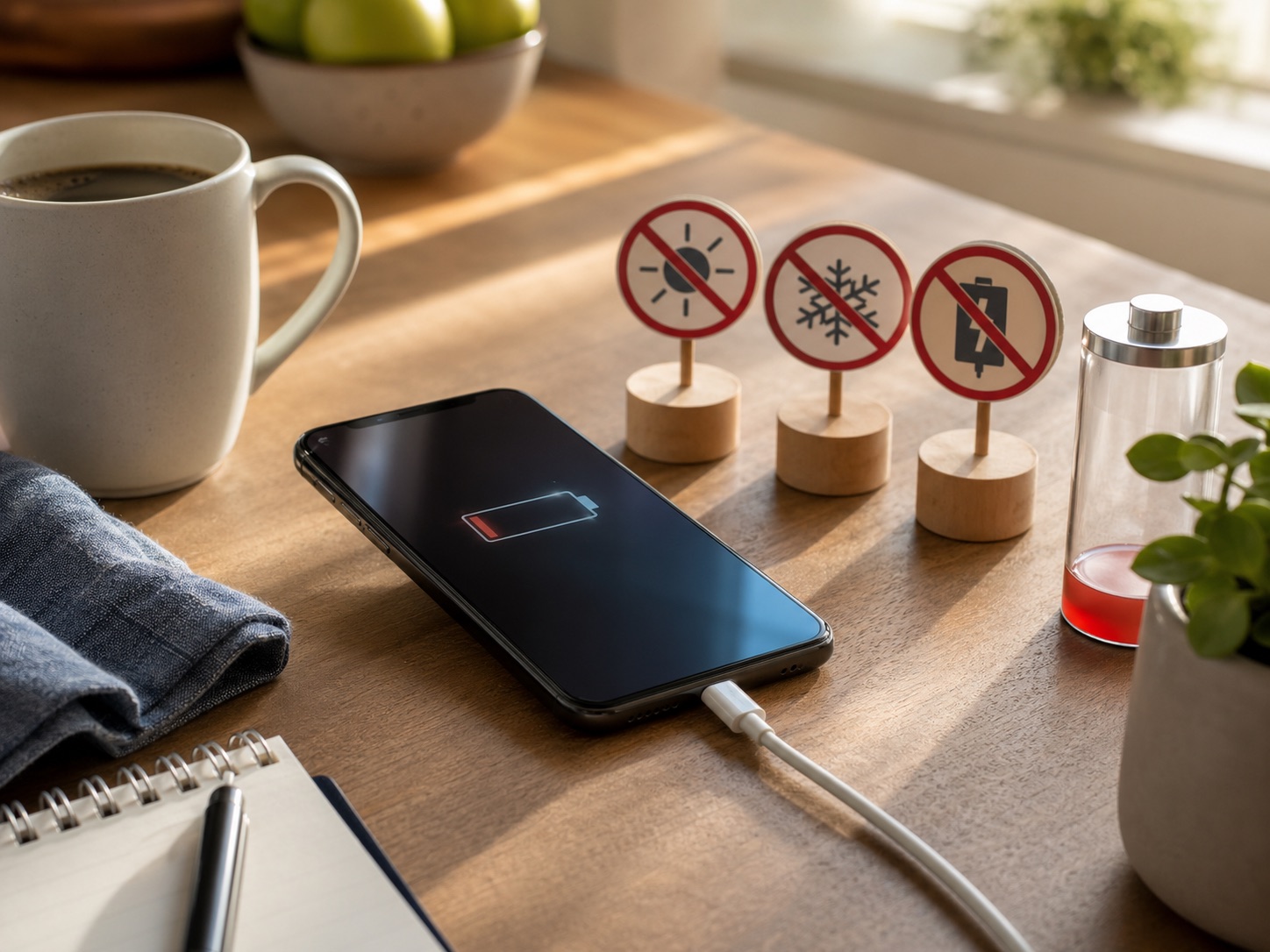
Battery advice ages like milk. The tips you got when you bought your first smartphone in 2014 are mostly wrong now, modern lithium-ion batteries, modern operating systems, and modern charging hardware behave nothing like the early-iPhone era they were written for.
Here are six common beliefs we hear weekly in the Nestphones chat, and what's actually true.
Myth 1, "Closing background apps saves battery"
False, and counterproductive.
iOS and Android both manage background apps aggressively. When an app is "in the background" on your home screen carousel, it's almost always frozen, using zero CPU, zero network, zero battery. Closing it just means the next time you open it, the OS has to load it from scratch, which uses more battery than leaving it suspended.
The exception is apps that are genuinely misbehaving, playing audio, holding GPS, syncing, and the OS will tell you about those in the battery usage screen. Force-close those specifically. Leave the rest alone.
Myth 2, "Charging to 100% damages the battery"
Mostly false, with a kernel of truth.
Lithium-ion cells are happiest between 20% and 80% state of charge. Charging from 80% to 100% does add more wear per percentage point than charging from 40% to 60%.
But every modern flagship, iPhone, Galaxy, Pixel, has a battery management feature that holds the charge at 80% overnight and finishes the last 20% just before your alarm. Turn it on once and forget about it. Stressing about manually unplugging at 80% in 2026 is solving a problem your phone already solved.
What about charging to exactly 50%?
For long-term storage (a phone you won't use for months), yes, store at ~50%. For daily use, no, it makes no measurable difference and you'll just run out of battery sooner.
Myth 3, "Fast charging kills your battery"
Partially true, but engineered around.
Yes, higher current and voltage produce more heat, and heat is the actual battery killer. But modern fast charging protocols (PD, SuperVOOC, HyperCharge) ramp the current down aggressively as the cell heats up. A phone advertising "120W charging" is only at 120W for the first 5 minutes.
After three years, the difference in battery health between a phone fast-charged daily and one slow-charged daily is typically 2-4 percentage points of capacity. Real, but not enough to change behavior over.
Myth 4, "You should let the battery die completely once a month to recalibrate it"
False. This was true for nickel-cadmium batteries in 2005.
Lithium-ion has no "memory effect". Letting the phone die to 0% actually stresses the cell more than topping up at 30%. The "calibration" advice you're remembering came from laptop batteries 15 years ago and survived in folklore long after the chemistry changed.
Myth 5, "Wireless charging is bad for the battery"
Partially true.
Wireless charging is less efficient, most of the lost energy becomes heat, and heat is the enemy. A phone wireless-charged daily will degrade marginally faster than one cabled.
But the magnitude is small. If you genuinely prefer wireless for convenience (bedside, car mount), the trade is fine. If you're chasing maximum battery longevity, prefer cable.
Myth 6, "Replacing the battery is impossible / not worth it"
False on both counts.
For phones two to three years old where battery health has dropped to 80% or below, an authorized battery replacement is the single highest-value upgrade you can do. Apple charges roughly 12,000 DZD for an iPhone 14 battery in Algiers. That phone runs another two years instead of being replaced.
Avoid Ouedkniss "battery replacement" listings unless the seller can prove they're using genuine cells with a proper temperature-controlled press. Cheap cells from unverified sources are the most common cause of swollen batteries, far more dangerous than a tired-but-original cell.
What actually drains battery (the real list)
In rough order of impact:
- Screen brightness, by a wide margin
- 5G in poor coverage areas, the phone hunts for signal continuously
- Always-on display, convenient but expensive
- Background location for too many apps (check Settings → Privacy → Location)
- Push email on aggressive sync (15 min vs 1h vs manual)
Manage those five and you've manageed 80% of phone battery life. Everything else is folklore.


